

Behind the “It’s a Lenovo” Campaign: Why This Project Meant So Much More Than Marketing
When I first joined The PRIMA Group as a student at St. John Fisher University years ago, I never imagined I would one day return as part of a global campaign collaboration between Lenovo, a Rochester production company, and the same student organization that helped shape my own career.
At the time, PRIMA felt enormous to me. It was one of the first environments where I experienced what real marketing collaboration looked like outside of a classroom. Deadlines mattered. Presentations mattered. Creative thinking mattered. You learned quickly that good ideas alone were not enough. You had to communicate them clearly, organize people around them, and execute them under pressure.
Like a lot of students involved in organizations like PRIMA, I probably did not fully appreciate the long-term impact it would have on my career while I was actually in it. Looking back now, though, it is easy to draw a straight line between those experiences and the work I do today.
That is part of the reason the “It’s a Lenovo” campaign became so personally meaningful to me.
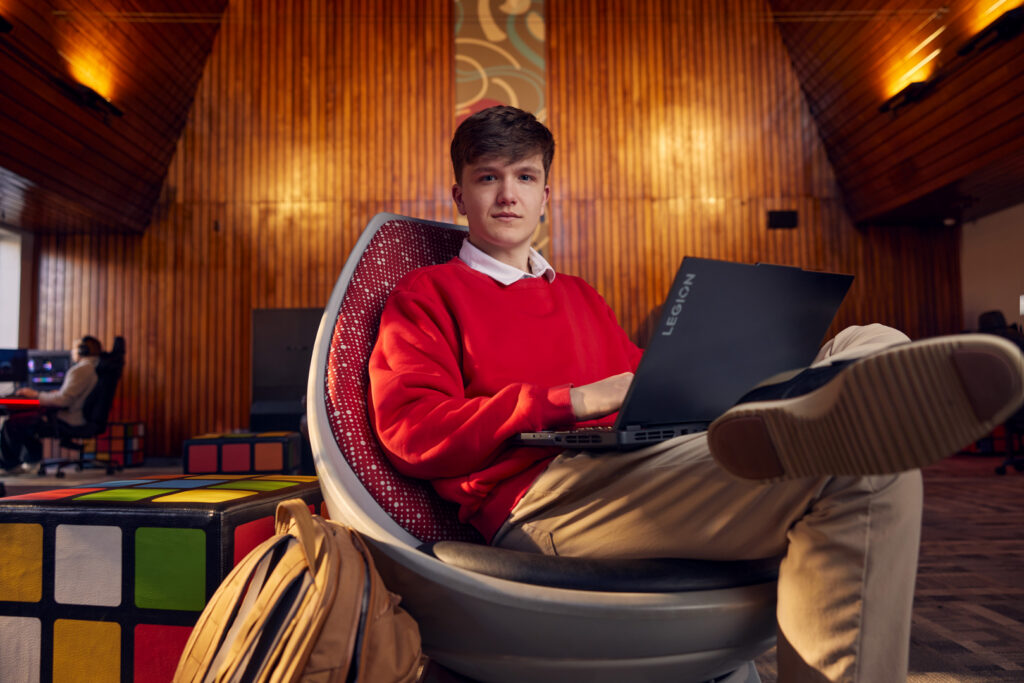
What started as a content initiative for Lenovo Global eCommerce quickly evolved into something much larger: a true collaboration between Lenovo, St. John Fisher University’s PRIMA Agency, and Rochester-based production company Optic Sky. The goal of the campaign was to create authentic, Gen Z-focused storytelling around how technology fits naturally into the lives of students and young professionals. But from the beginning, I knew authenticity could not simply be manufactured in a conference room by corporate marketers trying to guess what younger audiences cared about.
The students themselves needed to help shape the project.
And they absolutely did.
This was never a situation where students were simply handed instructions and told what to say on camera. The PRIMA team contributed creatively and strategically throughout the process. They participated in planning discussions, helped shape the direction of the videos, appeared as on-screen talent, coordinated logistics locally in Rochester, and developed follow-up content that extended the life of the campaign well beyond the primary shoot.
What made the process even more interesting was the fact that most of the collaboration happened remotely. I was managing the project from North Carolina while the students, production teams, and campus coordination were all happening in Rochester. In many ways, the project became an exercise in trust. Trusting students to take ownership. Trusting collaborators to execute creatively. Trusting that giving people real responsibility would elevate the work rather than complicate it.
Thankfully, that trust paid off.
The final campaign became something that felt genuinely human, which is increasingly rare in modern marketing. A lot of brands talk about authenticity right now, especially when discussing Gen Z audiences, but authenticity is difficult to fake. Younger audiences are incredibly good at recognizing when something has been overly manufactured or filtered through too many layers of corporate polish.
That is why this project worked.
The students were not pretending to be the audience. They were the audience. Their perspectives, interests, concerns, and personalities naturally shaped the creative in ways that would have been difficult to artificially recreate through research alone.
At the same time, the students gained something equally valuable in return.

This was not a simulated classroom assignment or hypothetical campaign exercise. They were working on a real global campaign for a Fortune 150 company with real expectations, real deadlines, real approvals, and real activation plans. The campaign assets were ultimately used across multiple channels and markets, giving the students an opportunity to experience the kind of collaborative marketing environment many professionals do not encounter until years into their careers.
Watching them rise to that challenge was honestly one of the most rewarding parts of the entire experience.
I also have to give enormous credit to Aaron Gordon and the entire Optic Sky team throughout this process. They did an incredible job balancing professionalism with mentorship, and they treated the students like legitimate creative collaborators from day one. That matters. Students know when they are being patronized, and they also know when they are being trusted. Optic Sky helped create an environment where everyone involved felt ownership over the final product, and I think the quality of the work reflects that.
Personally, one of the most emotional parts of the project was simply seeing PRIMA again after all these years and realizing how strong the organization still is. You always hope the things that mattered to you continue thriving after you leave them, but there is something uniquely satisfying about seeing a student organization you care deeply about not only survive, but continue evolving in impressive ways.
I walked into this project expecting to mentor students. Instead, I walked away incredibly impressed by them.
Their professionalism.
Their creativity.
Their organization.
Their confidence.
Their ability to adapt.
It genuinely made me proud to be associated with the group.
In a strange way, the campaign itself became a reflection of what good marketing should probably look like more often. Less top-down messaging. More collaboration. Less assumption-making about audiences. More direct involvement from the people brands are actually trying to reach.
That approach benefited everyone involved.
Lenovo gained authentic insight and storytelling directly connected to Gen Z perspectives. The students gained meaningful real-world experience working on a globally activated campaign. The production team gained a collaborative creative environment that produced genuinely strong work. And for me personally, I gained the opportunity to give something back to an organization and university that played an important role in my own life.
That part matters to me more than the nomination itself.
Of course, being recognized by AMA Rochester and the Pinnacle Awards is incredibly exciting. Any time work you care about receives recognition from peers and industry professionals, it is meaningful. But what I will remember most about this project years from now is not the nomination. It will be the experience of seeing collaboration work exactly the way people always claim it should.
Students being trusted.
Professionals mentoring without ego.
Creative teams sharing ownership.
Different generations learning from each other instead of talking past each other.
That is what made this project special.
And honestly, I think audiences can feel the difference when work is created that way.